Computational Sensing and Information Processing Lab
Department of Electrical and Computer Engineering
University of California, Riverside
Directed by M. Salman Asif
We build sensing systems and algorithms that recover the signals hidden in indirect, incomplete, or corrupted measurements. Our work spans computational imaging and optics, inverse problems, and machine learning — with a recent focus on wavefront sensing, robust multimodal learning, and trustworthy AI. We combine physics-based models with data-driven priors, and validate the results on hardware prototypes and real multimodal datasets.
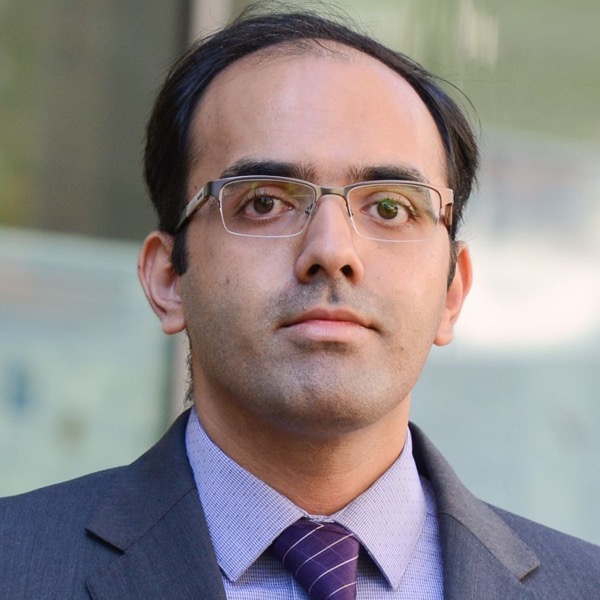 M. Salman Asif, Director
Research
Our work groups into the four threads below. The publications section lists the projects behind them, and the director's page has the full research overview.
Team
- Director M. Salman Asif, Professor, Electrical and Computer Engineering
- 2022 – present Yaoteng Tan, PhD ECE
- 2022 – present Nebiyou Yismaw, PhD ECE
- 2023 – present Yash Garg, PhD ECE
- 2025 – present Robert Moseley, PhD CSE
The full team member and alumni list is on the team page.
Publications
Selected work with project pages, newest first. The full list is on Google Scholar and the director's publications page.
Computational Imaging & Optics
-
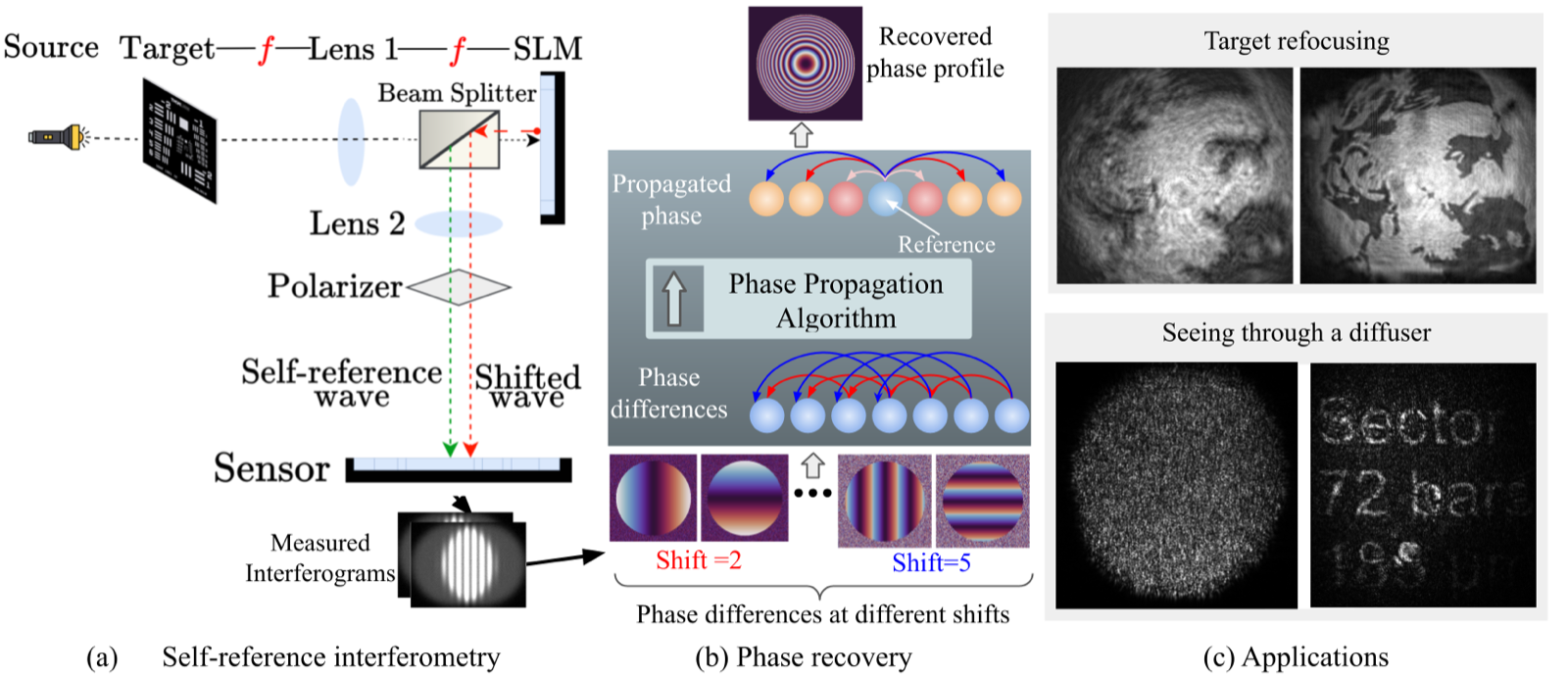
Interfering an incoming wave with spatially shifted copies of itself removes the need for a stable reference beam. We recover the global phase by propagating pairwise differences across a connected graph, and prove that co-prime shifts guarantee connectivity and bound error accumulation — recovering complete phase profiles from as few as eight measurements, validated on a hardware prototype.
Inverse Problems
-
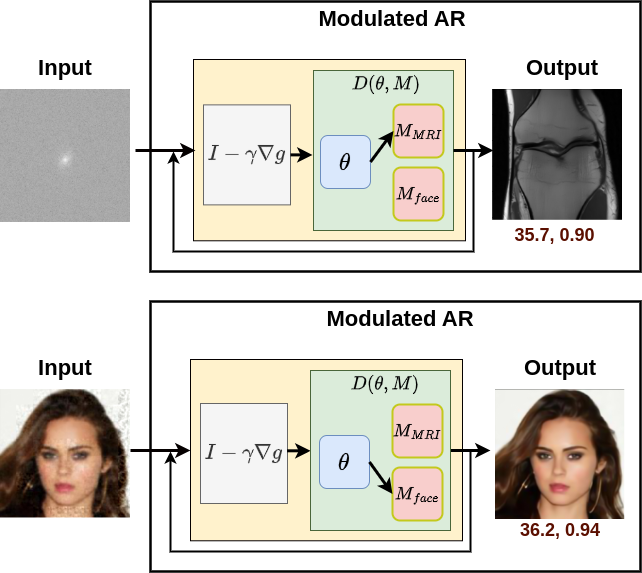
Networks trained to solve inverse problems are fragile under shifts in data distribution, measurement operator, and noise level. We characterize the effects of those shifts and propose a flexible, parameter-efficient framework that adapts a pretrained network to expand its domain of validity.
Robust Multimodal Learning
-
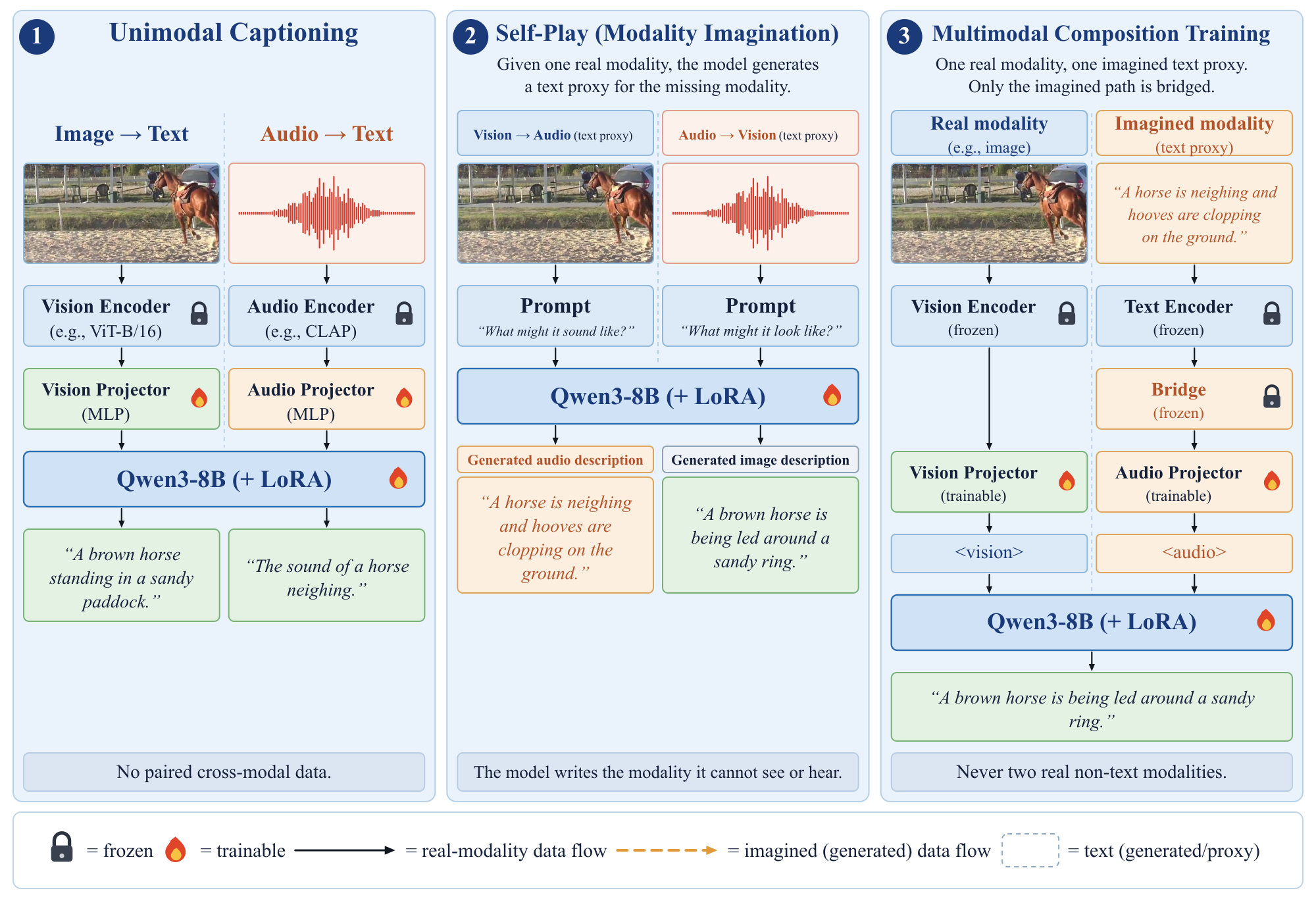
MSP teaches a multimodal LLM to reason over image and audio together without any paired cross-modal data. Given one real modality, the model writes a text proxy for the missing one, and these self-generated proxies train cross-modal composition. It sets the best zero-shot result on AVQA among methods not trained on it and beats OneLLM by +18.05 on MUSIC-AVQA.
-
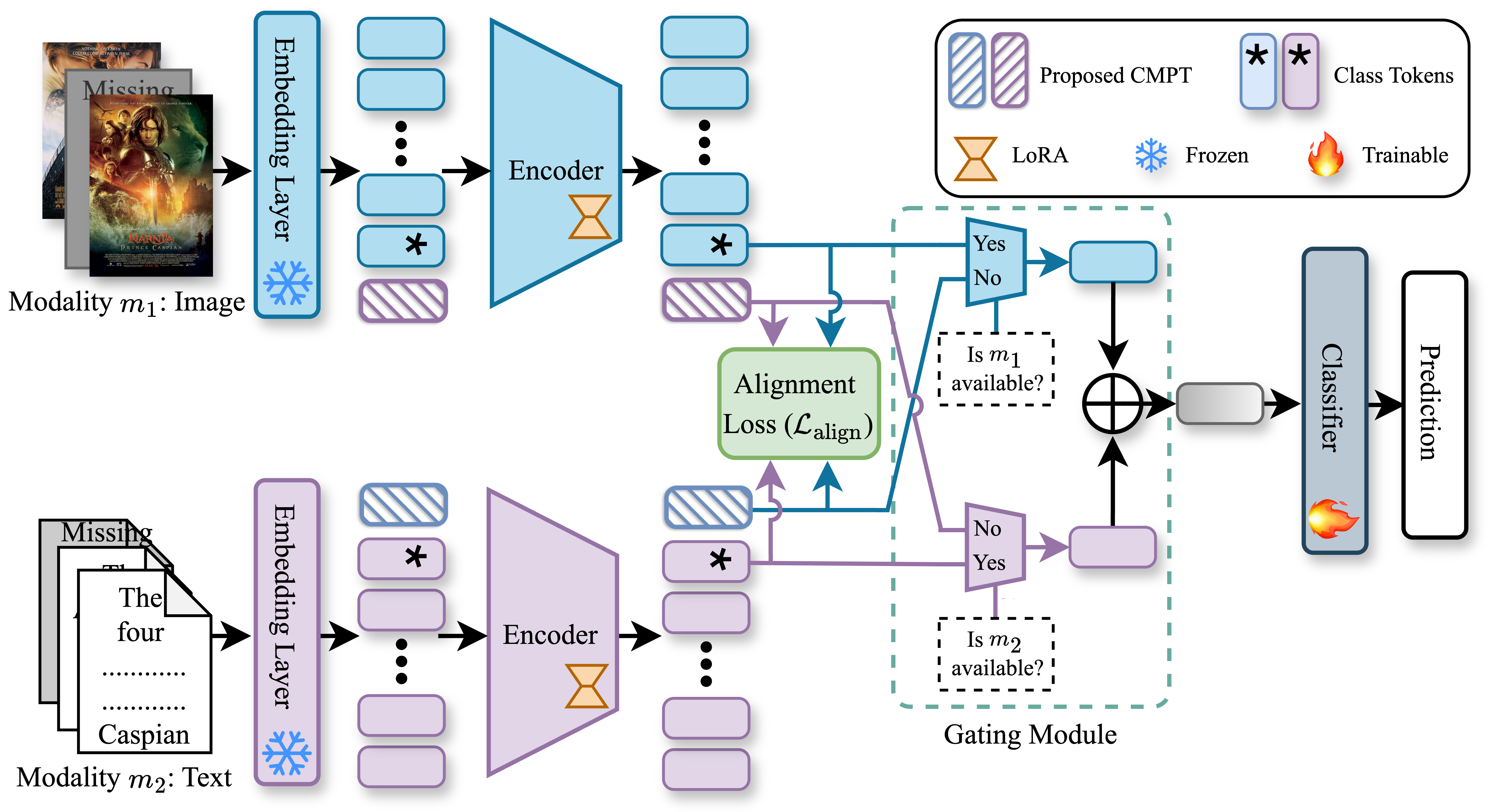
Cross-modal proxy tokens approximate the class token of a missing modality by attending only to the tokens of the available modality — no modality generation, no auxiliary networks. With rank-1 LoRA adapters in frozen unimodal encoders, this beats state-of-the-art baselines across missing rates on five datasets while staying competitive with complete modalities.
-
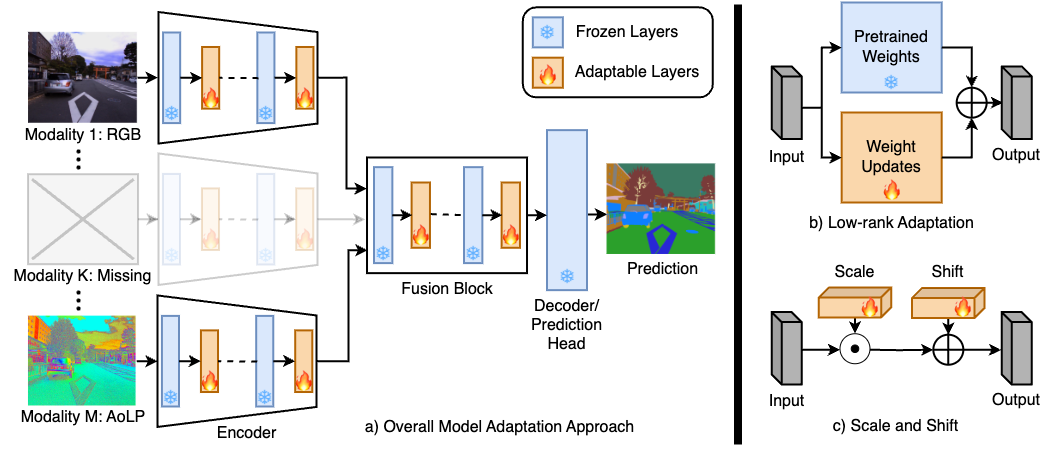
Pretrained multimodal networks degrade sharply when a modality is absent at test time. Modulating intermediate features with fewer than 1% of the model's parameters compensates for the missing inputs, and often beats dedicated networks trained for each available modality combination — demonstrated on five tasks across seven datasets.
-
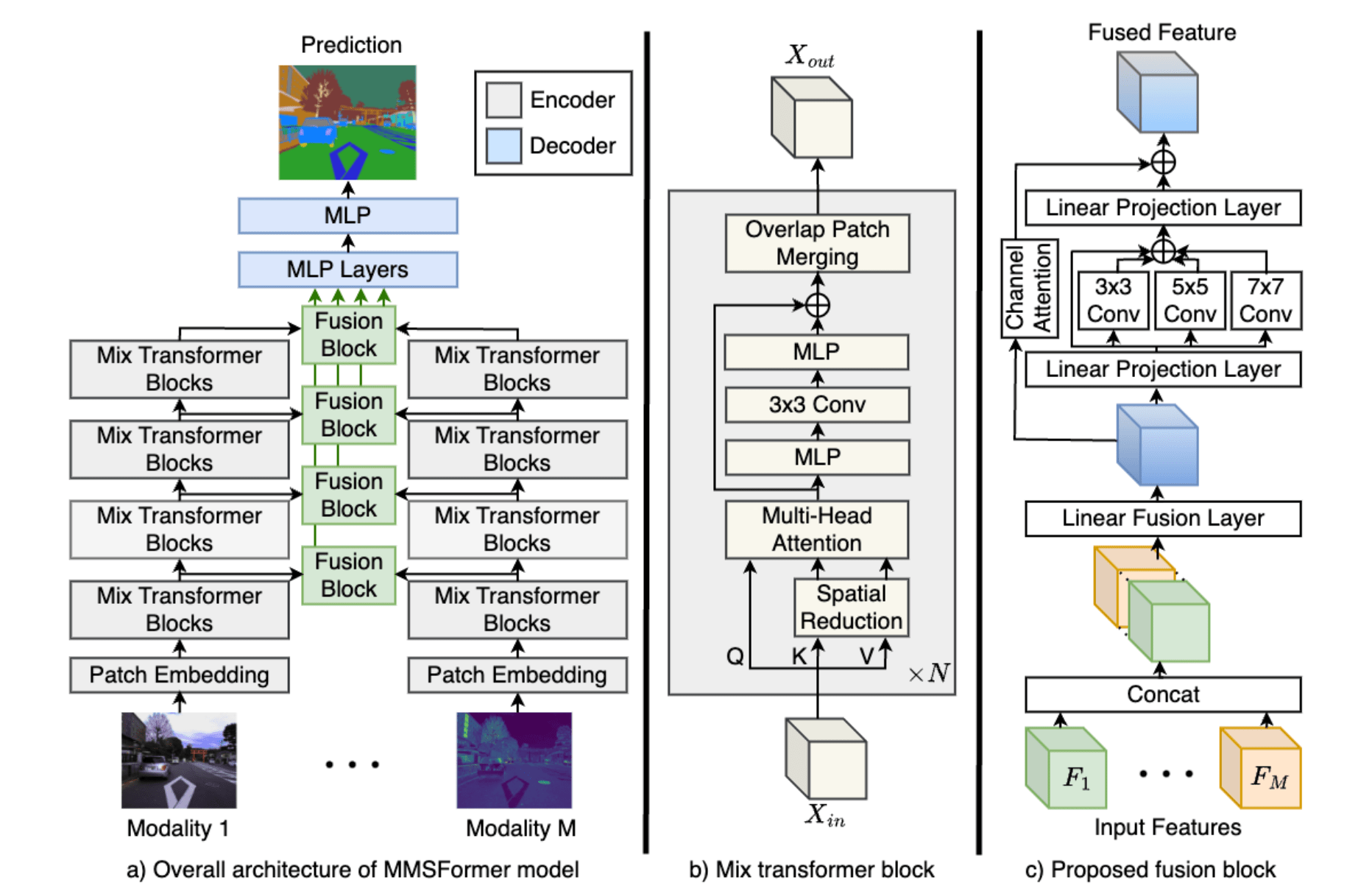
A mixed-modality fusion block that combines information from arbitrary modality combinations, built into a Multi-Modal Segmentation TransFormer for material and semantic segmentation. Accuracy improves monotonically as modalities are added, setting state of the art on three datasets.
Trustworthy Machine Learning
-
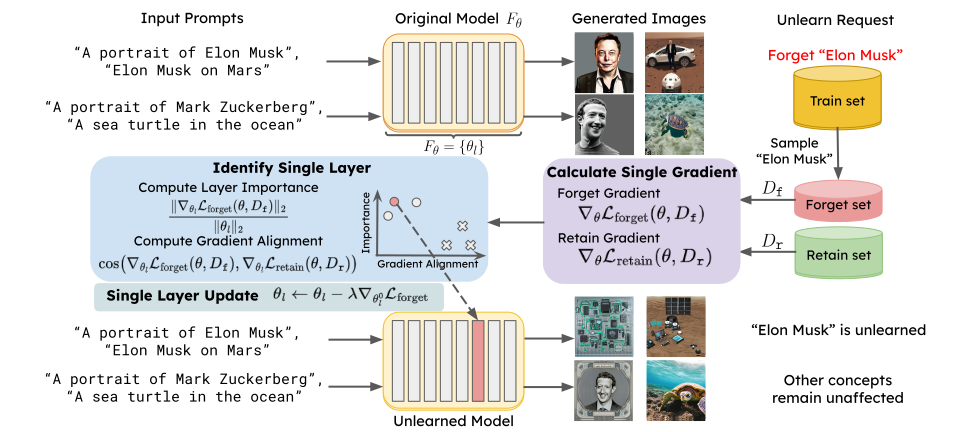
SLUG unlearns targeted information by updating a single critical layer from a one-time gradient computation, using layer-importance and gradient-alignment metrics to pick that layer. It removes concrete and abstract concepts from CLIP, Stable Diffusion, and VLMs at a small fraction of the compute of existing methods.
Tutorials
-
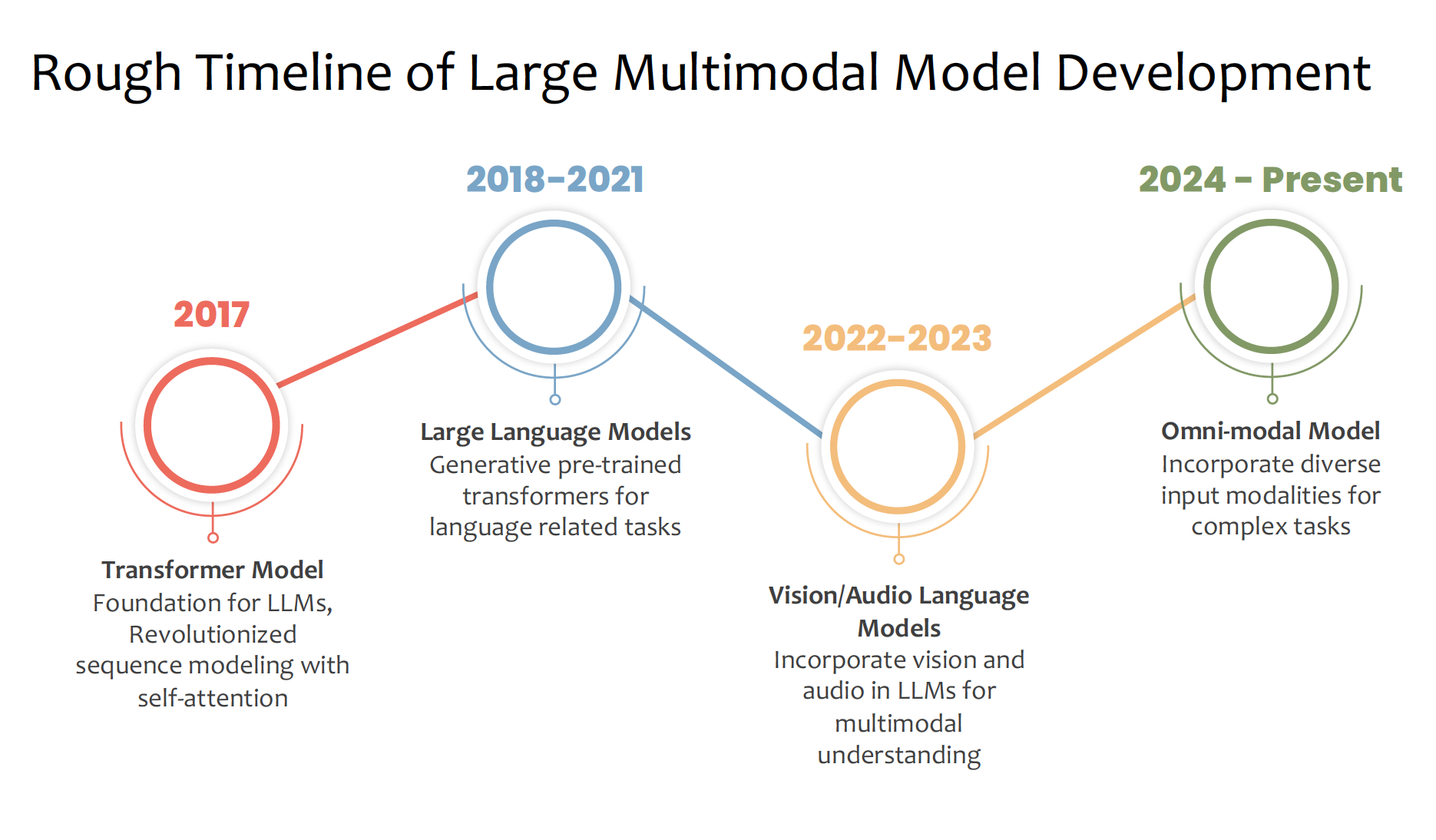
A tutorial overview of robust multimodal learning, from the fundamentals of fusion, alignment, and representation learning through the architectures and models that keep performance from collapsing when modalities are noisy or missing.
2026
-
MSP teaches a multimodal LLM to reason over image and audio together without any paired cross-modal data. Given one real modality, the model writes a text proxy for the missing one, and these self-generated proxies train cross-modal composition. It sets the best zero-shot result on AVQA among methods not trained on it and beats OneLLM by +18.05 on MUSIC-AVQA.